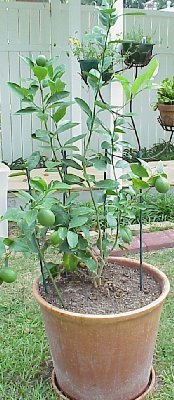
Citrus limon ‘Meyer’
The Meyer Lemon Tree is a hardy variety and the best lemon tree for subtropical climates such as the Gulf Coast of the United States. The Meyer lemon is not actually a true lemon but a cross between a lemon and a mandarin orange. While it keeps most of the characteristics of a lemon, it has a bit less acidity, less bitterness, more sweetness and a thinner skin. Its skin lacks the typical zest of a true lemon. It has gained favor because it bears a heavy crop and is a relatively hardy plant.
- Performs best in full sun (at least 8 hours per day).
- Needs regular water and well-drained soil. No wet feet.
- Hardy to 25 degrees Fahrenheit (-4 degrees Celsius). Preferred U.S. hardiness zones: 9, 10 and 11.
- Can be grown in a pot to restrict its size, or in areas that can get a heavy freeze.
- Grows to 15 feet tall and wide, or larger, if planted in the ground.
- Sandy, well-drained, dry, alkaline soil works best, though it tolerates acidic soil if necessary. Low salt tolerance.
- Rounded growth habit and a medium rate of growth.
- Used as a patio tree, screen, fruit tree and specimen plant.
Harvest
The Meyer lemon bears heavily when mature, and its crop grows as the plant matures. It may bear 10 or more lemons even at 3 years old. The fruit is green until it matures; when ripe on the tree, it turns a yellow-orange color. That will take longer than you expect. The main crop matures in summer. In a tropical climate, a Meyer lemon tree can bear fruit nearly all year long.
Care
Guard against snails, which can eat the buds and leaves of the Meyer lemon tree.
After 3 or 4 years in a pot, replace the soil, since it will be exhausted of nutrients. You can either replant into a larger pot, or cut away some of the outer roots with a sharp, strong knife and replant in the same pot with fresh soil.
History
The Meyer lemon is named for Frank Meyer, who brought it to the United States from China in 1908 while working for the USDA. The tree became very popular and was widely grown until the mid-1940s, when it was found to carry a virus that attacked other citrus trees. Meyer lemon trees were then banned in the United States to protect other lemon varieties. A virus-free version was developed and reintroduced in 1970, and since then the Meyer lemon has become a favorite of home growers. This variety is especially sweet and succulent. Because of its thin skin, the Meyer lemon does not survive shipping well, so it is not widely grown by commercial lemon growers.
Our tree was bought from Lowe’s in the spring of 2002. The picture was taken in June 2002, shortly after it was planted in this pot. The tree needs shaping: the lowest branches removed and the upper branches pruned halfway back to promote more branching.